Why businesses want to be chosen as a Fund partner
Add an agreed culture-euro amount to selected product sales, and your marketing budget grows as you sell. Countercult brings the trust, curation, logistics, and experience to turn it into relevant work, while paid local culture strengthens the local economy.
The honest version of the offer
A Fund partnership is not a sponsorship invoice or a promise of guaranteed customer acquisition. The business adds an agreed culture-euro amount to selected product sales, so each sale can grow a budget for its marketing or experiences. Before starting, the business and Countercult agree how sales and contributions will be recorded.
You already have a business to run. Countercult is the artist-run partner that brings trusted local relationships, curation, logistics, and production experience. We shape the brief, find and commission the right cultural workers, and manage delivery so the business does not have to build a programme from scratch. The commission supports paid local cultural work and a clearer route for value to circulate in the community.
What the available evidence says
The figures come from an American Independent Business Alliance analysis, summarized by the University of Minnesota Duluth. They describe local economic circulation, not a guaranteed sales lift from a Fund partnership.
The third comes from Arts & Economic Prosperity 6, which analysed 2022 activity around nonprofit arts and culture in the United States. The study found $151.7 billion in total economic activity: $73.3 billion from organisations and $78.4 billion in event-related audience spending. That audience spending includes the wider outing-food, transport, parking, childcare, and other local purchases-not only the cultural ticket.
In other words, culture can be part of a local economy. The sensible business question is not “will art make us go viral?” It is “can we create a real, well-paid local reason for people to visit, return, talk, and spend time here?”
Why businesses want to be selected
- Better local marketing. The business gets a specific, human story instead of generic purpose language.
- Useful cultural intelligence. Countercult helps make the connection locally relevant rather than choosing a random artist or visual style.
- A customer touchpoint. The contribution can live on a receipt, menu, product label, checkout card, or in-store message.
- Support through the whole process. Countercult brings trust, curation, logistics, and delivery, so the business can keep its attention on its customers and day-to-day work.
The Fund makes it simpler to connect a sales-built budget to a focused commission. Countercult brings the local cultural context, artist selection, logistics, and production experience; the business brings its knowledge of the customer and the work it needs.
Martha’s Burgers: the pilot in plain sight
On Saturday 23 May, Shona Neary hosted Party, Burgers, & Cultural Investment at Martha’s Delicious Burgers on Mehringdamm in Berlin. The event was framed as a Countercult Exchange pilot: a way to test whether an independently owned food business could fund local culture through the normal rhythm of a busy street weekend.
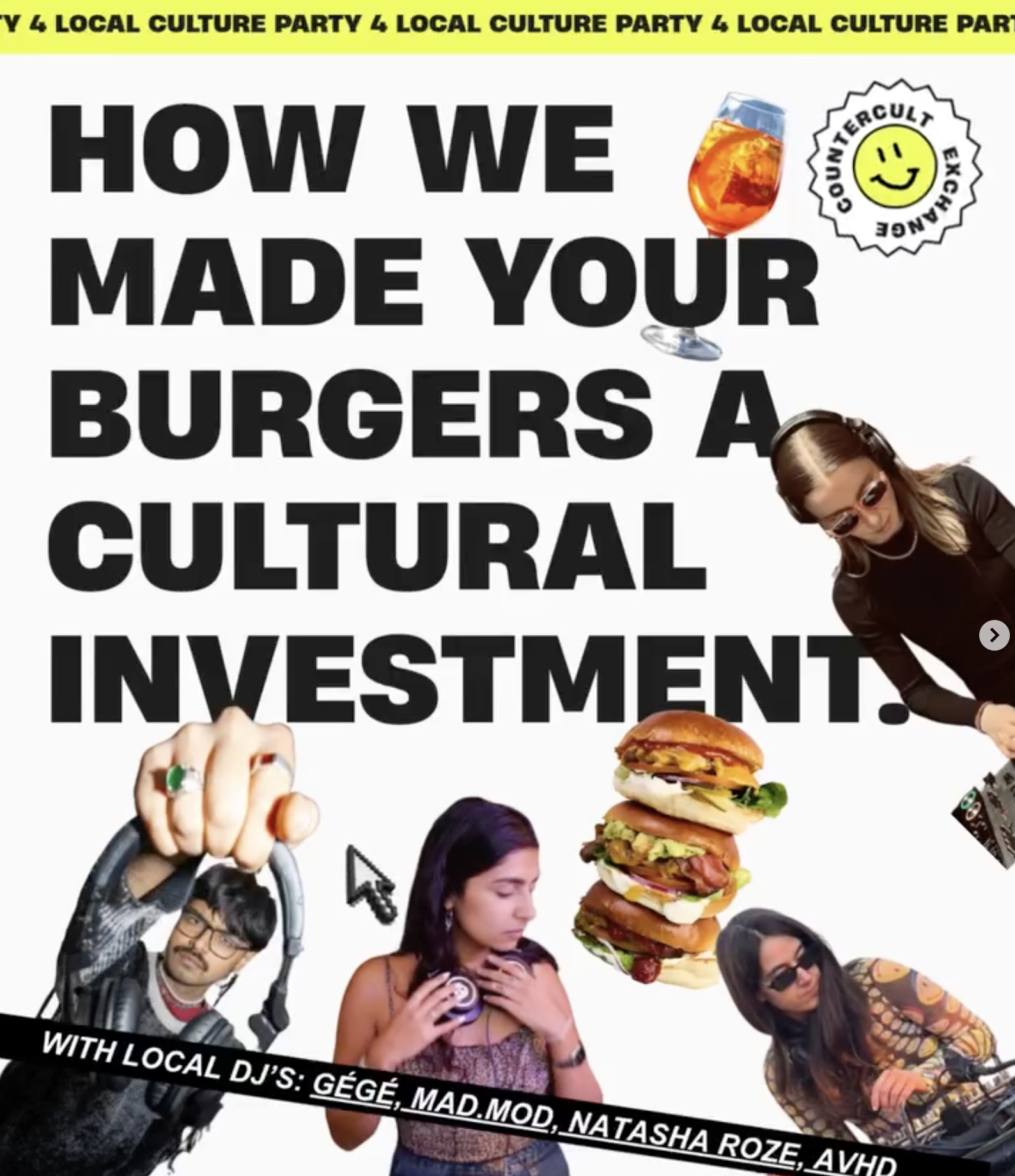
The proposition was deliberately direct: come hungry, feed an independent business, hear local electronic music, and help fund an artist’s career. The Countercult Combo (€9.50) and Aperol Spritz (€6) gave the idea a simple public form rather than turning it into a distant sponsorship message.
The mechanism
The event copy described a direct slice of food and drink revenue staying with the local artists playing live in the windows. The artists named were mad.mod__, natasharoze, gege_bln, and avhdworks. This pilot showed how a clear customer experience could connect independent retail to paid creative work. The archived material does not say that a literal culture euro was added to each sale or that Countercult held the revenue; this event predates and should not be mistaken for the current proposed sales-built Fund arrangement.
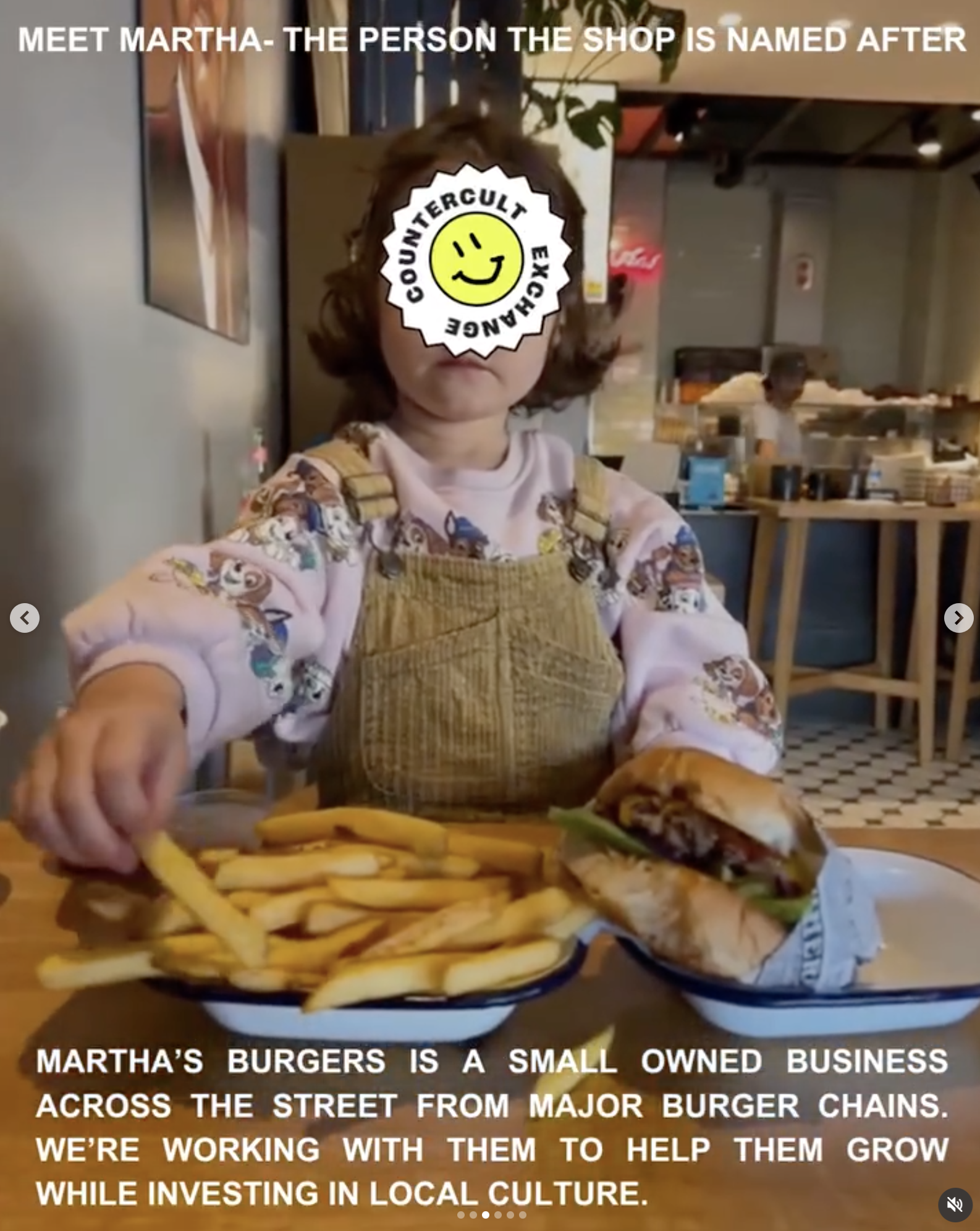
The listing also used a local-spending comparison: “keeping your money local leaves 68% of every dollar completely inside the community, compared to less than 14% at global corporate chains,” citing ACT Insurance. We are treating that as the event’s stated rationale, not as a Countercult measurement or a universal guarantee; local multipliers vary by business, supply chain, and place.
Why this matters for a Fund partner
Martha’s Burgers did not need to become an arts organisation or manage every detail alone. The pilot brought a strong local idea, relevant artists, and an understandable customer experience together around the business. Today, a culture-euro amount on selected products can grow a marketing budget sale by sale; Countercult brings the trust, curation, logistics, and experience to manage the creative work while the business keeps serving its customers.
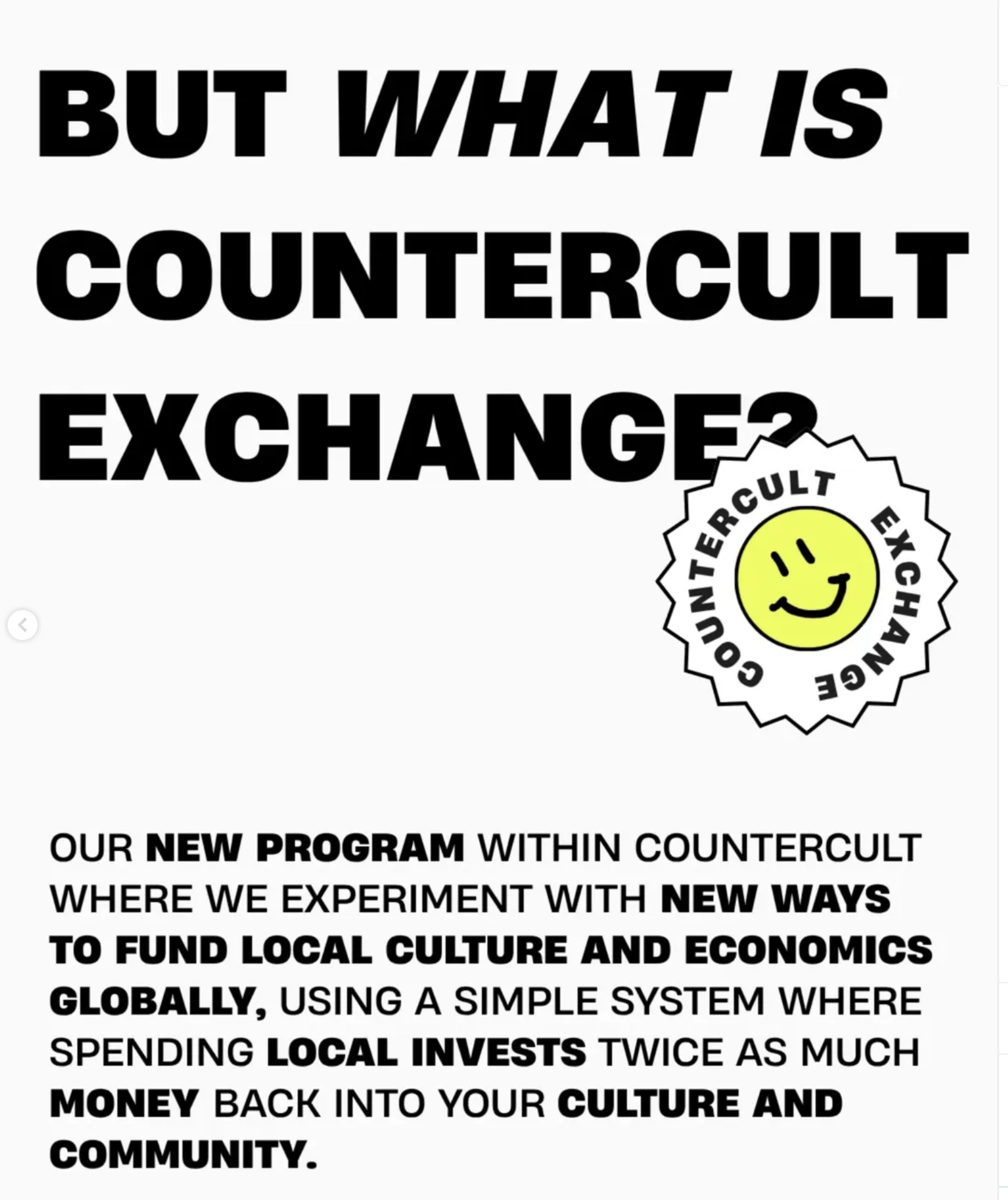
The pilot’s larger question was whether a hyper-local model could be repeated beyond Berlin. Countercult continues to explore that question. The point is not that one lunch pays for an ecosystem, but that ordinary commerce can be designed to return more value to the people and places that make a neighbourhood worth visiting, supporting an ethical local circular economy. No particular sales increase is guaranteed.
Do not borrow the look of a culture while ignoring the people who keep it alive.
That principle from the Countercult Studios manifesto is the boundary around the Fund. The contribution has to become a paid relationship, not a decorative claim.
What a Fund partner should measure
Keep the measurement practical: how many products carried the contribution, how much was generated, who was paid, how many customers noticed or asked about it, whether people returned, and whether the business wants to do another commission. Those signals are more useful than promising a neat percentage lift that the Fund cannot honestly guarantee.
Want to be considered?
Apply to be one of Countercult’s Fund partners. We are looking for businesses with a strong local relationship and a reason to make culture part of the customer experience.
Sources: American Express / PayPal, “We Asked, They Answered: Five Insights From Shoppers on What They Want from Small Businesses” (2023; survey of 396 shoppers); Americans for the Arts, Arts & Economic Prosperity 6 (national findings, 2022 activity); National Endowment for the Arts, Economic Impact of Arts and Cultural Institutions; and the Martha’s Burgers / Countercult Exchange event listing supplied by Shona Neary, accessed from the provided screenshots because the original Luma URL currently returns 404. The evidence describes association and economic activity, not a guaranteed return on a Fund partnership.
This piece was informed by Shona Neary’s writing, conversations, and thinking around independent culture, artists, and place.
editorial process: Our Journals are pulled from our writings over the years to get information out as quickly and as widely as possible, and to get to what matters: finding each other and claiming our seat in the circular economy. Some ideas overlap between Shona Neary's work on cultural infrastructure and their artist practice as Sketchy Shona. AI is a tool for infrastructure, not for creating Journal writing or artists' work. We welcome original reporting and pitches from journalists and independent publishers.